
CONTENT PLANNING • BUSINESSES NATIONWIDE
Turn five customer questions into a useful content week
By Viral Digital Marketing · Published October 13, 2026
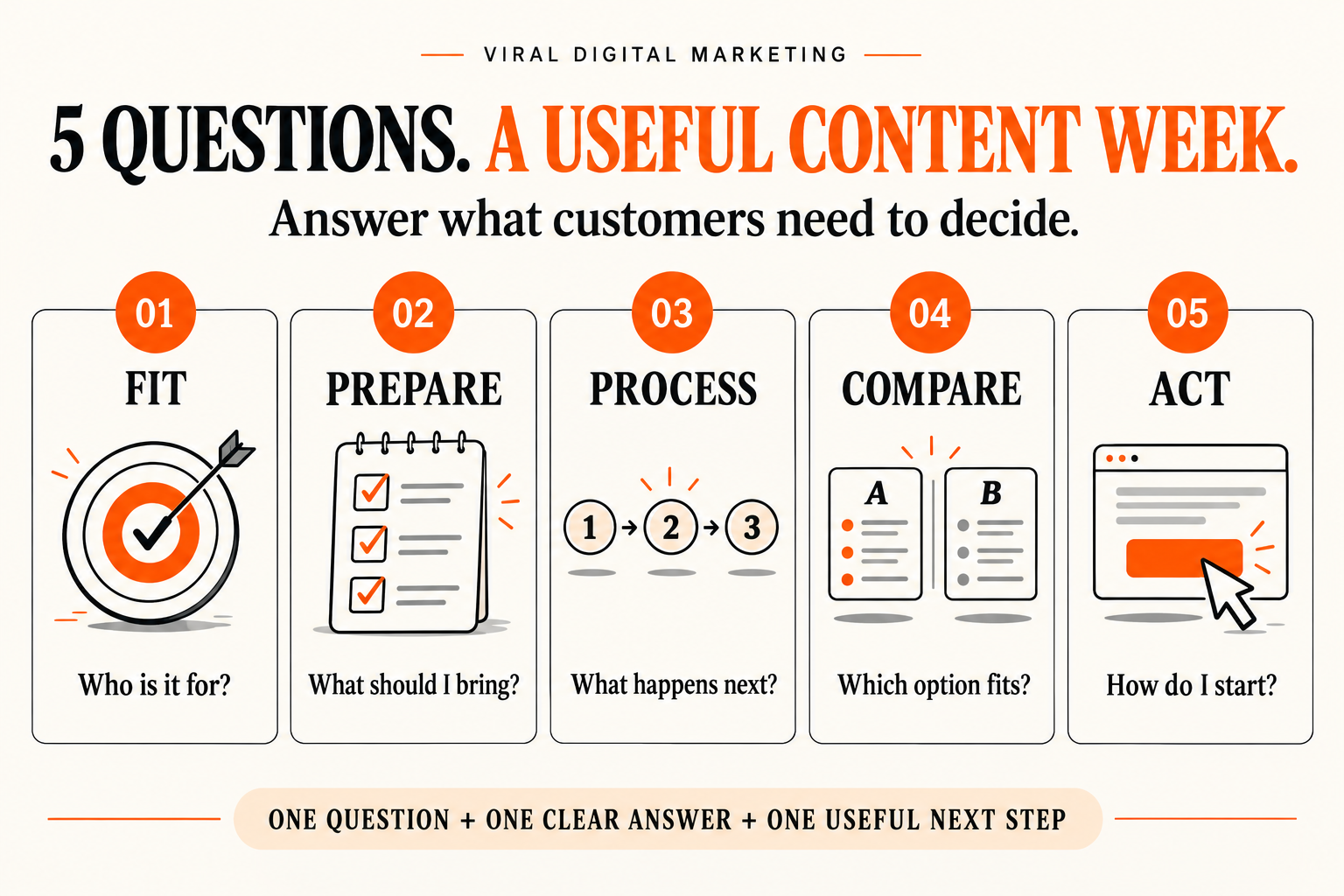
A useful content plan starts with a decision your customer needs to make. Gather five real questions, answer each clearly, and give every answer a sensible next step.
This approach works for service businesses across the United States, including Bakersfield and Santa Clarita. It gives website articles, social posts and short videos a shared purpose without repeating the same sales pitch.
Start with questions you can answer honestly
Ask the person who handles inquiries which questions come up before a customer decides. Review your own approved notes and existing website FAQs. Summarize the question without names, contact details or private circumstances. Keep customer quotations, images and stories out of public drafts unless you have appropriate permission.
Choose questions that help someone understand fit, prepare for a service or take the next step. “Why are we the best?” usually invites an unsupported claim. “What is included in the first visit?” can produce a specific, useful answer.
Before starting a new article, check whether your website already answers the same question. Improve that page when it needs clarification. Google’s people-first content guidance emphasizes useful, original information and warns against adding content merely to make a site seem fresh. A posting schedule is not a ranking guarantee.
Build five pieces around five different decisions
The examples below describe a hypothetical service business. They are prompts to adapt, not claims about a particular company or its results.
1. Fit: “Is this service right for me?”
Explain the problem the service addresses, who it suits and a meaningful limitation. A home-service company could describe the kinds of projects it handles and the information needed to assess an unfamiliar request. Confirm the actual service area rather than implying an office in every city.
Useful format: a short FAQ or one focused graphic. Next step: the relevant service page, where the visitor can check scope before contacting you.
2. Prepare: “What should I have ready?”
Create a small checklist using your real intake process. Depending on the service, that might mean approximate dimensions, the model of an item or a description of the problem. Separate essential details from optional ones. Explain the approved private channel for submitting anything sensitive.
Useful format: a checklist post with the same information in text. Next step: preparation instructions or an estimate page that explains what happens next.
3. Process: “What happens after I contact you?”
Describe the actual sequence from inquiry to review and the next conversation. Name the stages in plain language. Distinguish requesting a time from receiving a confirmed appointment, and include a response window only if the team can maintain it.
Useful format: a simple step diagram or a short captioned explanation. Next step: the contact page with an accurate description of the handoff.
4. Compare: “Which option fits my situation?”
Compare two real options using the same criteria: scope, preparation, ongoing responsibilities and exclusions. Explain when each may fit. Avoid presenting a larger package as automatically better, and use only verified prices or terms.
Useful format: two clearly labelled lists or a readable comparison graphic. Next step: a detailed service description or a consultation for questions the comparison cannot resolve.
5. Act: “How do I start?”
Show one clear route to inquire or book. Say what information is needed and what the visitor should expect after submitting it. Test the destination on a phone before sharing the link; our mobile booking-page checklist covers the journey through confirmation and team receipt.
Useful format: a short walkthrough using a demonstration account with no customer data. Next step: the correct inquiry or booking page.
Give each draft a small production brief
For every piece, record the customer question, the answer in one sentence, the supporting fact or approved example, the format, the destination link, the reviewer and the planned publication date. If nobody can verify the answer, return it for clarification before designing the graphic.
Keep an authoritative version of changing details on your website. A social post can explain one part and link to the fuller answer. Change the opening and presentation to suit the format, but keep the underlying facts consistent. Do not turn one answer into five almost identical blog posts.
Make the answer readable beyond the graphic
Put essential instructions in ordinary text as well as the visual. Use clear type, sufficient contrast and a layout that remains readable on a phone. For a meaningful image, write alt text that communicates its purpose in context, following W3C’s guidance for informative images.
For video with meaningful audio, provide synchronized captions and review their accuracy. Include speech and relevant sounds needed to understand the message. W3C’s caption guidance explains why unchecked automatic captions can miss or change meaning. Label illustrative graphics honestly; do not present a generated scene as a real customer project.
Use the next round of questions to improve the plan
After publishing, note what people still ask and which explanations need clarification. If tracking is configured, review relevant page visits, link activity and inquiries with their limitations. Likes alone do not establish that a post created a customer, and a short-term change does not prove causation.
Keep the best answer current, correct unclear wording and choose the next question from real information gaps. That creates a practical content routine tied to customer decisions.
Plan content around your services
Viral Digital Marketing is based in Bakersfield and serves businesses nationwide. Explore our marketing and content services, view our service locations, or request a free consultation to discuss your content priorities.
Primary-source guidance checked October 13, 2026. All business examples are illustrative.